
How To Become Superhuman (Intelligence Isn't Enough)
The Forgotten Power Behind Deep Focus

Modern technology didn’t create your problems with attention. It “just” made them worse. The human struggle with distraction is part of the age-old problem of unfulfilled human potential.
Throughout history, passivity has led the average human to fall into a default state of weak attention and lethargy. On the other hand, the strength of intention is what differentiates those who snap out of collective hypnosis and live life to a higher level, no matter how strong the forces of distraction are.
This was the conclusion of the first essay of this series, You Will Live Like a Lobotomized Pigeon If You Don’t Reclaim Your Focus. (reading Part 1 isn’t necessary to understand and get value from this piece, but you should read it at some point to get the full picture)
Here is the shortest version of what I want to say in this part:
It’s not enough to understand, on a rational level, that a more intentional life is a more focused life, and that a more focused life is a life of meaning and self-actualization. If it were enough, one online article on habit development would turn you into a productivity machine once and for all.
You need more than your intellect. You need to (re)activate and strengthen your will. This requires focus and effort. In turn, stronger will increases your capacity for focus and effort. But will is not what you think it is. It’s certainly not the hustle bro concept of willpower.
Now, allow me to expand.
The Forgotten Human Power
Colin Wilson, the British philosopher whom I quoted in Part 1, said that life at times feels flat, lethargic, and void of meaning,
“…because I allow the will to become passive, and the senses close up. If I want more meaning, then I must force my senses wide open by an increased effort of will.” (New Pathways in Psychology)
“On the other hand, if man can ever come to grasp how completely he sustains his minute-to-minute, second-to-second existence by means of his will, the result will be a total change in the quality of human consciousness. (New Pathways in Psychology)
Many people reading this might find the word “will” too vague. And that’s not your fault. It’s one of psychology’s biggest failures. In the late 19th and early 20th century, psychology attained the rank of a science and began focusing almost exclusively on what could be measured and clearly defined. The will got downgraded to a minor point in the study of the human psyche.
That’s why most of you are used to hearing about the will only as part of the religious/philosophical debate on free will. Or, the main concept you have of the will is willpower, that is, the ability to brute-force your way through life. Although willpower as such is useful and sometimes necessary, it’s far from the whole picture of the human will. This misconception of the will is also known as “the Victorian will.” It’s been called “Victorian” because it was widely used during the Victorian period, especially in education.
In his book The Act of Will, Italian psychiatrist Roberto Assagioli explains the problem with Victorian will(power).
“The Victorian conception of the will still prevails, a conception of something stern and forbidding, which condemns and represses most of the other aspects of human nature. But such a misconception might be called a caricature of the will… It is such misuse that has brought the will into disrepute, producing a violent reaction against it which has swung to the other extreme: a tendency to refuse any kind of control and discipline of drives, urges, wishes, whims—a cult of unbridled “spontaneity.”
I addressed this harmful misconception of the will in more detail in my essay on Why Creative People Don’t Get Shit Done.
Will is a force that mobilizes and organizes our inner resources. Besides Assagioli, another great of 20th-century psychology, Rollo May, defined will in a concise and helpful way.
“Will is the capacity to organize one’s self so that movement in a certain direction or toward a certain goal may take place.” — Rollo May (Love and Will)
“The will is the synthetic power which coordinates, organizes and directs all the other faculties...” — Roberto Assagioli
“The true function of the will is not to act against the personality drives to force the accomplishment of one’s purposes. The will has a directive and regulatory function; it balances and constructively utilizes all the other activities and energies of the human being without repressing any of them.” — Roberto Assagioli (The Act of Will)
Given these definitions, another question might arise: why did I turn the conversation from intention and focus to will?
Why the will is crucial for our conversation might be best explained by the thinker who unsuccessfully tried to make it one of the central questions of psychology - William James.
“The most essential achievement of the will,... when it is most ‘voluntary’, is to attend to a difficult object and hold it fast before the mind...” Effort of attention is thus the essential phenomenon of will.” (Principles of Psychology)
And once again, Rollo May, this time acknowledging and building on the underrated psychological genius of James.
“When we analyze will with all the tools modern psychoanalysis brings us, we shall find ourselves pushed back to the level of attention or intention as the seat of will. The effort which goes into the exercise of will is really effort of attention; the strain in willing is the effort to keep the consciousness clear, i.e., the strain of keeping the attention focused.” (Love and Will)
In Part 1, we noticed how we grow lethargic when we’re not focused. Now, with an expanded understanding of attention as inseparable from the will, we can update our statement:
Lethargy and lack of focus result from allowing our will to become passive. At the same time, our will being passive makes it harder for us to focus. Vicious cycle.
Now, let’s break the vicious cycle by making it more tangible.
Awakening The Will
Imagine a person doing bicep curls at the gym. Yes, I’m really going to use bicep curls as an analogy for one of the most important topics in psychology and philosophy. To all the hyper-intellectuals, deal with it.
In each hand, the person is holding a dumbbell that’s far too light. If someone put a gun to their head and made them curl the weight until they cannot lift either arm, they would be able to do over 50 reps. But no one is holding a gun to their head, and they don’t intend to do 50-rep sets.
They are curling the weight. Technically, they are at the gym, exercising. However, because the lack of challenge, they are everywhere but at the gym. As they go through the motions, they think about what they’ll eat afterward, worry about how much work they’ll have to do in the office tomorrow, and reflect on an argument they had with their partner a week ago. Very little real physical training is going on there.
The problem isn’t the light weight itself. A person training with intention and focus would be able to properly stimulate their muscles with that same weight. The only downside of the light weight is that it allows the person to mentally check out and operate on autopilot – it doesn’t demand focus.
Let’s imagine I approach this person and try to help them. I take dumbbells that are three times as heavy as the ones they were using, maybe even heavier. I ask them to curl the weight. Now, they are forced to focus. They have to tense not only their muscles but also their mind and their will. They can’t just go through the motions. The autopilot is turned off and now the real person is participating in the experience. They are fully focused.
Obviously, this isn’t the most optimal and sustainable long-term training strategy. However, it’s a way of snapping out of passivity. It’s a way of awakening the will.
We can easily see how this applies to life as a whole. Most people fail to consistently pursue their goals. It’s not that they don’t have the capacity for it. It’s that they operate with underdeveloped focus and intention. And their focus and intention are weak because they spend most of their lives curling the weight that’s far too light for them. What people need is the intellectual, creative, and even moral equivalent of a heavy weight that will force them to focus.
What I’m calling heavy weight is similar to the concept of “super-focus” by the Armenian mystic and philosopher, G. I. Gurdjieff. Gurdjieff believed people spend most of their lives “asleep.” Intense effort, both mental and physical, done for its own sake rather than for the external reward, was one of his main ways of getting people to “wake up.”
Summarizing Gurdjieff’s core idea, Colin Wilson explains that,
“Western man’s concept of knowledge is built on a fundamental error: the notion that the acquisition of knowledge only requires intelligence. It requires, in fact, a kind of action. Consciousness needs to be put into its ‘active gear.’”
Even before Gurdjieff was trying to wake people up, William James was writing about our unused inner resources. In his essay Energies of Men, he says that all humans are to some extent victims of the “habit-neurosis,” that is, “the habit of inferiority to our full self.”
“Compared to what we ought to be, we are only half awake. Our fires are damped, our drafts are checked. We are making use of only a small part of our possible mental and physical resources.” (Energies of Men)
“Stating the thing broadly, the human individual thus lives usually far within his limits; he possesses power of various sorts which he habitually fails to use. He energizes below his maximum, and he behaves below his optimum… his life is contracted like the field of vision of a hysteric subject—but with less excuse, for the poor hysteric is diseased, while in the rest of us, it is only an inveterate habit—the habit of inferiority to our full self—that is bad.” (Energies of Men)
Why Awakening Isn’t Enough
All the thinkers I’m referencing here and in Part 1 – James, Maslow, Wilson, Csikszentmihalyi, May, Gurdjieff – wanted to help humans switch to that “active gear” of consciousness.
The most straightforward way to put consciousness into active gear after a prolonged period of passivity and lethargy is to take on a challenge that demands focus, as I tried to describe with the bicep curls analogy. James even talked about the success of the “bullying treatment,” that is, forcing the person to engage in an effort that seems overwhelming, which ends up showing they were selling themselves short.
Put simply, we need effort to activate and train our will. A stronger will, in turn, allows us to keep consciousness in active gear.
However, that’s not the full picture.
We cannot continually rely on increasingly more difficult challenges to live an intentional and focused life. We need to find a way to engage in less challenging tasks with the same intention and focus we bring to those “super-efforts.” We need to learn how to treat the light weight with the same respect as the heavy weight.
But how?
James hinted at this, but I believe his exploration remained incomplete. Talking about how people tap into deeper reserves of their power, he wrote:
“Either some unusual stimulus fills them with emotional excitement, or some unusual idea of necessity induces them to make an extra effort of will. Excitements, ideas and efforts… are what carry us over the dam’. (Energies of Men)
We need to find a way to attribute adequate importance and \ or excitement to tasks and activities that are not forcing us to focus like the greater challenges are. Which brings me to one thing all the mentioned thinkers, except Rollo May, left out of their discussion of a more intentional and focused life: the power of narrative. To be more precise, personal mythology.
What better and more potent way to tie excitement, sense of meaning, and importance to a task than to perceive it as an integral part of the story of your life, a necessary step on your journey?
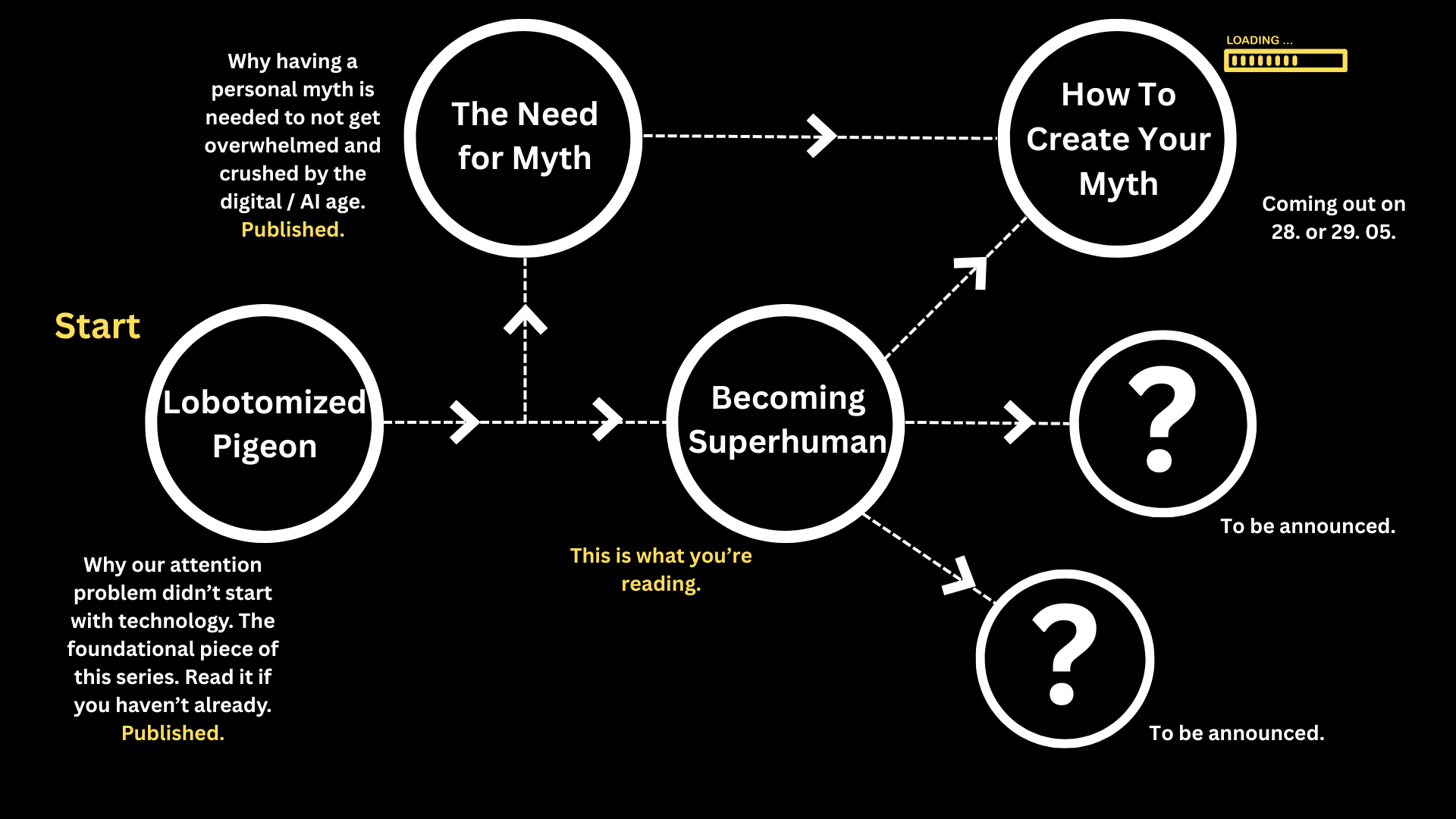
This is what I talked about in my piece on why You Will Not Survive the AI Age if You Don’t Have a Personal Myth. Since it was intended as a companion piece in this essay series, I will refrain from repeating myself here and ask you to read it if you haven’t already.
The reason I took this detour is to present the full picture: Yes, we need a stronger will. But we need a narrative it fits into.
A person who is capable of mobilizing their inner powers to accomplish their goal, but doesn’t have a healthy narrative (myth) that informs those goals, is at risk of:
wasting their energy on unfulfilling pursuits (hustle culture bros)
use the strength of their will in destructive ways (Hitler, Stalin, Trump, Epstein)
On the other hand, a person with a strong personal myth who doesn’t activate and train their will through effort remains forever in the realm of imagination. That’s the sad reality of most creative people.
Let’s summarize what we learned about making better use of our will up to this point.
Awakening the will
Waking up from the sleep of “habit-neurosis” and lethargy happens when we encounter a challenge that demands far more from us than we are used to accessing from within. This type of challenge can come unexpectedly from life circumstances. Or we can voluntarily engage in it, as I tried to describe with the example of “heavy weight.” These challenges, whether voluntary or unexpected, are supposed to be a recurring part of our lives. But they are not meant to be a daily practice.
Personal Mythology
Engaging in your personal mythology is a practice, not of training the will but of keeping the will active and aligned with your long-term vision. It is meant to be a daily practice.
Since the companion piece treats the concept of personal mythology in detail, and its sequel on how to find your myth is coming out next week, I won’t discuss it further here.
But it is not enough to awaken your will with the intellectual or creative equivalent of heavy weights. It’s not enough to identify your personal myth.
You must cultivate, that is, train, your will. Daily.
Training The Will
As Roberto Assagioli writes in The Act of Will,
“This inward flame, however, if left to itself, pales and flickers out, or gives forth only intermittent flashes. It must be assiduously nourished in order that it may shine brightly and vividly. The newly awakened will easily becomes overpowered by a thousand ideas and imaginings, is driven asunder by desires and emotions that agitate us. It is necessary to protect it, to cultivate it, to exercise it.”
“Muscles become stronger by a series of contractions. In the same way, our will grows by “willing.’ In order to strengthen a specific muscle, or group of muscles, as in the case of a weakened limb, there are exercises arranged in such a way as to put into motion only that weak part of the body. In a similar manner, in order to strengthen the will, it is best to exercise it independently of every other psychological function.”
How do we train the will?
Do things precisely because you don’t want to do them. That’s the simplest and most straightforward way of training the will. And I’m a living proof of it.
To go beyond theory and quoting thinkers of the past, I will share my personal experience with training the will. In doing so, I will do my best so that it does not sound like blowing my own horn.
If you asked me what one principle I honored in my life most consistently and for the longest, it’s the principle of effort for effort’s sake. I don’t think there’s been a single day since the summer of 2016, when my self-education journey started, that I haven’t consciously chosen to do something I would’ve preferred not to do.
Naturally, this found its way into my writing.
Ever since I started writing online in December 2019, I have talked about doing difficult things for their own sake. Not because I wanted to position myself as a discipline guru or the next David Goggins. On the contrary, I wanted to become a part of “serious philosophy” circles a bit too much. However, I had already experienced that intentional effort goes way beyond developing your body or becoming a tough guy. It’s an integral component of inner development.
One of my earliest Substack pieces was about 5 stupid but effective things I do to build discipline and willpower. In it, I describe choosing to do certain things throughout the day, not because of their benefit but simply because I’ve noticed internal resistance toward doing them. Later in my writing, I started calling this “micro-sucks.” (I don’t claim to have coined the term.)
At that time, I wasn’t aware that William James was talking about micro-sucks 130 years earlier.
“Keep alive in yourself the faculty of making efforts by means of little useless exercises every day, that is to say, be systematically heroic every day in little unnecessary things; do something every other day, for the sole and simple reason that it is difficult and you would prefer not to do it, so that when the cruel hour of danger strikes, you will not be unnerved or unprepared. A self-discipline of this kind is similar to the insurance that one pays on one’s house and on one’s possessions. To pay the premium is not pleasant and possibly may never serve us, but should it happen that our house were burnt, the payment will save us from ruin. Similarly, the man who has accustomed himself steadily, day after day, to concentrating his attention, to will with energy, for instance, not to spend money on unnecessary things, will be well rewarded by his effort. When disasters occur, he will stand firm as a rock, even though faced on all sides by ruin, while his companions in distress will be swept aside as the chaff from the sieve.”
(Talks to Teachers)
This is probably one of the main reasons why I didn’t kill myself at the lowest point of my despair back in the summer of 2022, apart from my loved ones. When you’ve achieved at least one small victory over the weaker part of yourself every day for years, getting out of bed and giving another day a try might still be overwhelming, but it’s at least not impossible.
What do micro-sucks actually look like?
They don’t look impressive from the outside. And they’re not supposed to. These small challenges are supposed to be subjective. Meaning, it’s not the objective difficulty of the task that makes the micro-suck. 10 minutes of nonstop kettlebell snatches is objectively difficult, but I might enjoy that kind of effort. On the other hand, a 5-minute beginner stretching routine is incomparably easier to do, but I could be experiencing strong resistance to it because I find it boring. In this case, stretching is going to be more relevant for training my will, even though it’s an “easier” task.
Because it’s subjective, we all have countless daily micro-suck opportunities.
It can be taking the stairs. Or challenging yourself to take the longer route walking back home.
In my 2022 piece on “5 stupid things,” I gave the example of buying bananas when I don’t need them. As I’m preparing my oatmeal, I’m thinking of adding bananas to it. Then I see I don’t have any. I would need to go out and buy them in the convenience store on the ground floor of my building. “Well, I’ve already put enough fruit inside, I don’t really need the bananas” is my next thought. That’s where I notice myself trying to avoid what is really almost no effort and takes 5 minutes. Even though it’s true that I already put plenty of fruit in my oatmeal and don’t really need bananas, I go out to buy them. As James advised, I am doing it simply because I would prefer not to do it.
These might sound like ridiculous examples, but that would precisely be the mistake that prevents people from developing inner strength and self-trust. People tend to think they’ll finally rise to the standard of their higher possibilities when life’s big moments arrive. They can’t appreciate the importance of small opportunities for inner strength.
But, as Yamamoto Tsunetomo states in Hagakure, one of the greatest texts of samurai philosophy,
“If it were not for men who demonstrate valor on the tatami, one could not find them on the battlefield either.”
Those small, seemingly unimportant moments are the training ground of life.
However, microsucks can take two different forms. You can engage in spontaneous micro-sucks, as explained in the examples above. Here, your main task is to keep an eye out for the micro-suck opportunities.
Or, you can engage in pre-planned challenges. Stare at a dot on the wall for 5 minutes without looking away and with as little blinking as possible (great focus exercise as well). Buy a pack of matches, spill them all out, and then return the matches to the box one by one, with care, focus, and no rushing. Draw 50 circles on a piece of paper by investing maximum focus to draw every circle as precisely as possible.
Before I end this essay with some practical challenges for awakening the will, I want to reflect on how a strong and active will, or the lack of it, affects your consistency.
Why Consistency (Alone) Doesn’t Work
“Start small” is the most common consistency advice. It’s simple, straightforward, and it’s even easy. In fact, the whole point is that it’s easy. So, it should work for everyone, right? Well, it doesn’t. There’s almost no human who hasn’t heard the idea of starting small, but most people still struggle with consistency.
One part of the problem, even though important, is unrelated to the topic of this essay. Because of that, I will explain it as briefly as possible, and you can watch my YouTube video on consistency to hear me talk about it in more detail.
People fail to build consistency by “starting small” because they never make an agreement with themselves to count the “small.” I’ve been writing every day for over 6 years. Impressive, right? But what if I told you that these impressive streaks include hundreds of days where I wrote for just 5 minutes? Would you still count that as a writing day? It doesn’t matter if you would. I made an agreement with myself to count the days when I showed up, no matter how small the action was. What others count as “real” writing is irrelevant. Those 5-minute sessions helped me build the psychological momentum. This eventually led to 8-hour writing days and millions of people reading my writing.
If you just “start small,” but you don’t make an agreement with yourself to count and appreciate the small, you’re not building any psychological momentum.
However, learning to count the small isn’t enough.
Over the years, hundreds have passed through my online community and participated in my consistency challenge, and I’ve worked 1-1 with dozens on improving their consistency.
Here’s what I’ve found: Even when people stick to small, consistent action, it might not be taking them anywhere. Even though they’re showing up, they are not building anything – whether it’s an external or internal project they’re engaged in.
Why is that?
I’m arguing it’s because of the lack of super-efforts (”heavy weights”) and micro-sucks. Lethargic, passive will is the problem.
When a person hasn’t been challenging themselves on both macro and micro level to draw upon deeper reserves of their energy, minimal effort doesn’t have much of an effect. It just gives them the perfect opportunity to go through the motions. It becomes an always-available path of least resistance. If I’m counting 5 minutes of writing as a writing day, but I’m not keeping my consciousness in “active gear” through will training, then I’ll always settle for 5 minutes as “enough.”
To a person who doesn’t train their will, a 5-minute effort isn’t an opportunity to do something when they would otherwise do nothing. It’s an opportunity to do little when they could’ve done a lot.
It’s the opposite with a person who has awakened their will and is keeping their consciousness in active gear through will-training. They don’t default to the path of least resistance. For them, the mini option is an opportunity to still put in effort even when it seems they don’t have time or energy to do anything. That’s why 5 minutes of writing builds momentum for that person – because it naturally leads to longer writing sessions, while for the ‘passive will person,” the 5-minute option is precisely what prevents them from ever attempting anything more challenging.
What does all of this tell us? There is no moving forward while your will is passive. There is no getting unstuck until you put consciousness in active gear.
No productivity advice will help you if your ability to reach into the deeper reserves of your energy has atrophied.
So, let’s awaken your will.
Any challenge that asks more of you than you think you can give will bring you closer to a sense of using your will consciously and intentionally. I suggest engaging in both mental and physical effort.
Example:
Over the course of next week, complete the following:
-One 3-hour writing session where the only rules are: no getting up from the desk (unless you’re literally about to piss your pants, no engaging in any other task, no matter how productive, and no touching your phone. How many words you write and how satisfied you are with the quality of your writing is irrelevant.
-300 burpees as quickly as possible. 500 if you consider yourself fit. “As quickly as possible” means don’t spread out the effort over the day so that it stops being a challenge. There’s no good or bad result. The only thing that matters is that you push beyond your subjective limits.
*I’m using writing as an example that’s relevant for me and for a big portion of my audience. You can do anything else, as long as it’s one task. Also, there’s nothing special about burpees per se. It’s just an exercise that requires minimal space and skill, and allows anyone to challenge themselves today — no equipment or experience needed. If you have certain physical limitations, find a suitable alternative. For someone more experienced in training, of course, we could make this more creative. We could design a thrusters + devil presses ladder. But I’m not trying to make this a fitness programming article. We can have that conversation in the comments for anyone interested.
I have no doubt that your relationship with and control over your inner resources will be different after completing these two challenges. However, remember Assagioli’s warning. The flame goes out if left to itself. You need to nurture your flame with daily effort. That’s where micro-sucks come into play, whether spontaneous or pre-planned. And you can start implementing them right away.
So, as you go about your day, seek out opportunities to challenge the voice that keeps sending you down the path of least resistance. Because that’s the path of complacency, passivity, lethargy. It’s the path of becoming a shell of what you were supposed to be. On the other hand, the path of becoming superhuman in our age of distraction is simply about building your capacity to do what you set out to do.
For other sources of free value,
If you are interested in working with me on creating a stable internal and external structure so that you can show up for your life with the will, intention, and attention it deserves, go to this link.
I got the notification for this and, after reading, this was most likely the most important thing I could have read today.
Thank you.
I will certainly be reading more of you