
You Will Never Finish Your Projects if You Don't Change Your Identity
How to start finishing what you start


It took me 3 years to put out my first YouTube video. I recently did over 110 daily uploads in a row (long form, not shorts). This is a story about learning how to finish what you start.
A few days ago, I hosted a live workshop for over 200 people who joined from all over the world. Pretty cool, right?. What’s even more impressive is the amount of people who stuck around for the full 2 hours and kept engaging with meaningful questions. I mean, how many people nowadays even have a 2-hour attention span?
Throughout the workshop, I addressed, in greater depth and with more concrete examples, multiple topics I write about here or discuss on my YouTube channel.
However, there’s one idea that intrigued most people with how counterintuitive it seems at first, but turns out extremely helpful.
Project as an identity-builder
You have that project that you keep starting and stopping. You can’t seem to finish it.
We’re not talking about your long-term goal or your life’s mission, but a concrete project. Something that you should’ve completed in a few weeks or a month, but it’s now been multiple months, and it doesn’t seem like you’re close to finishing it.
Maybe it’s finishing a longer Substack essay. Or launching a website for your business. Making that YouTube video. Preparing a speech. Whatever it is, you keep starting and stopping and doubting.
Part of my work is that I often talk to people in this situation. Regardless of their project, they all have one thing in common: thinking of themselves as people who don’t finish what they start.
This is where it stops being a conversation about the project and starts being about identity. Or at least it should.
Therefore, we must answer this question before even trying to continue:
“Do you care more about this single project or about becoming the person who finishes what they start?”
A few people in the workshop asked, “Aren’t these two the same thing?”
No. Absolutely not.
Caring more about the project means being strict about not changing its scope or self-imposed quality expectations. It means you care about completing this single project in the way you imagine it should be completed more than you care about the bigger picture.
But if you prioritize becoming the person who finishes what they start, every project can be bent and adjusted to that larger mission. A project can even be strategically abandoned. That might sound counterintuitive, but I’ll explain soon why it’s not.
Prioritizing this single project is rather childish, unless you’re someone with utmost confidence that they will finish what you start, regardless of the magnitude of the project. But I guess that type of person wouldn’t be reading this.
Prioritizing identity and inner narrative is the responsible attitude toward your potential.
This is how I see the current project affecting your identity.
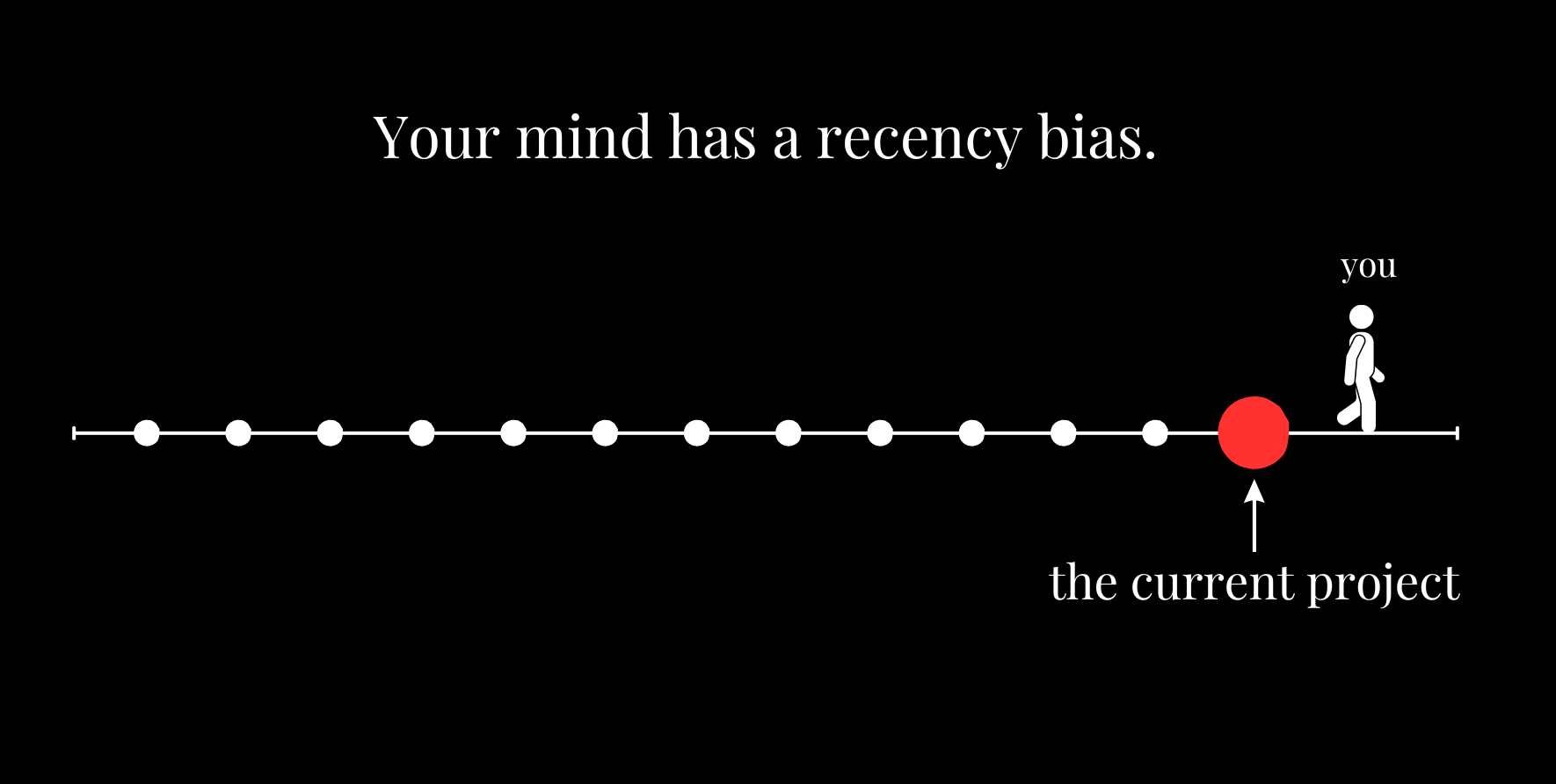
Your past is full of projects you took on. Some more successful, some less. Some completed, some not. All those projects show an overall trend that influences your identity. But my claim is that the most recent project holds the most weight, especially if you’ve been dragging it out for quite some time.
If the most recent project is the most relevant for your identity, then the task is clear. The highest priority is to ensure the most recent project is a completed project, not to complete the current project only in the way you originally planned.
Whether you’re sold on this idea and want to learn how to act on it, or it still doesn’t make sense and you need concrete examples—I got you.
Lower the bar
The first approach is to stick with the current “problematic” project but lower the bar so you can make sure to complete it.
How much to lower the bar? So much so that you become confident in your ability to complete the project. So much so that not completing a project would mean you chose not to complete it.
How to lower the bar? Reduce the scope and lower the quality expectations. “But I don’t want to,” you might say. Well, I guess you should go back and read this piece from the beginning.
Example: It took me 3 years to put out my first YouTube video. I recently did over 110 daily uploads in a row (long form, not shorts). The 3-year wait was mainly a product of refusing to lower the bar. I “had” to learn how to edit, and I “had” to learn how to narrate better, and I “had” to create this documentary-level video on the concept of existential anxiety. So I tried, and stopped, and planned, and tried, and stopped, and planned again... Until one day, I somehow finally realized that, if I want to make and upload YouTube videos, I need to become someone who makes and uploads YouTube videos. Crazy how that works, right?
Lowering the bar looks different for different people, even if the project is the same. For me, it meant filming with my phone, zero equipment besides a mic, zero editing, and uploading from the phone. The least amount of resistance possible. Today, 260 videos later, I can say I’m a person who makes and uploads YouTube videos.
Side-Step
The second approach is to “strategically abandon” the current project, as mentioned previously in the text. It means setting aside the project you’ve been struggling to finish and choosing one that is more manageable. The new project can be anything, as long as it’s relevant to your life and interests. However, it’s even better if it’s in the same or similar category as the previous project.
Example: One of my clients, a young writer, was recently in the ideation phase of an essay far larger in scope of topics and depth of research than anything he’s written before. Although he wasn’t in a situation where he was spending months starting and stopping, this essay had obvious potential to become that type of project. His confidence in completing and publishing the essay in a reasonable timeframe wasn’t high. We were risking losing momentum in the early stages of his online writing journey. After one conversation, it was clear that lowering the bar wasn’t an option. At least not to the extent I described in the first approach above. So, we agreed on a side step. He would write an opinion piece that requires no research. Something short, just to keep the pen sharp, the ball rolling, the creative juices flowing. And he did. He’s now researching and will soon be writing that challenging essay with increased confidence and momentum.
Both lowering the bar and the side step have one necessary component in common: a HARD deadline.
Whichever approach you choose, you must select a deadline. Remember, the whole point is to get that sense of completion, which contributes to your identity as a person who finishes what they start. That won’t happen unless there is a sense of urgency created by a date you committed to.
Since urgency is increased by a sense of external accountability, let me end by asking you:
What is your project?
If you’ve been struggling to finish it, will you lower the bar or take a side step?
What’s the deadline you’re committing to?
Reply in the comments if you’re up for it.
Thank you for reading.
This reminded me of an interview with a tennis player years ago who had had a losing streak and the coach set up a series of matches against players at a lower level to get her back into the habit of winning.
I guess it's a similar principle. Incompletes or losses erode confidence, so manufacturing a few easy wins gets you back on track.
For me, I have been writing for a living for twenty-ahem years but had a couple of years out working for a company as communications director. I stepped away from that but hadn't gotten back into anything until a couple of months ago my mum asked me if I had written anything lately, and that prompted me to just start again. But I got a bit in the weeds with worldbuilding for a while, until I eventually decided to do the worldbuilding publicly and publish the artifacts as well as the stories. Sometime we have to work with our procrastinating, shiny-objects-chasing selves instead of trying to fight them.
well written mate.